Challenge: Chromatic voice-leading arpeggios
Using your favourite solution, start on your ‘home pitch’ in the chromatic scale and ascend/descend chromatically in through the arpeggios. Here’s an illustrated example using tritone-separated I-ii diatonic triad pairs:

| Pitch | F | F# | G | G# | A | Bb | B | C | C# | D | D# | E |
| Triad | F | B | Gm | C#m | F | Gm | B | F | C#m | Gm | B | C#m |
Note that each triad appears an equal number of times (3 times) in the complete sequence. By starting on different pitches (or using a different voice of the chord to create the ascending line) interesting melodic options will present themselves.
Note also that at no point does chromatic voice-leading of one primary voice actually produce the double-triad-pair sequence F-Gm-B-C#m in any order or orientation. Thus, we find that playing this as a sequence in ascending or descending order of root note yields some very interesting angular melodic shapes within each triad, and has a cool effect of destabilising the dual tonal centres and kind of mashing everything together.
You may select any voice as the ‘chromatic lead’ for this exercise – the 12-chord sequence will always be the same (reversed when descending) but the outer voice movement will vary greatly depending on which voice is the chromatic lead. Here’s a very simple exercise with the root note of the home chord F as the chromatic lead:
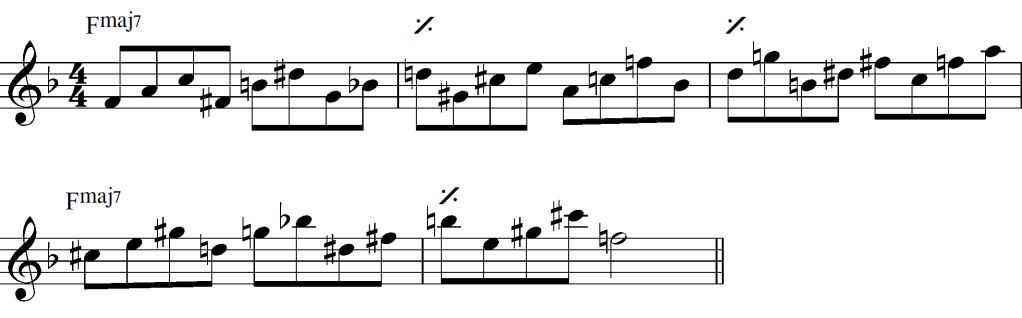
Sounds a little boring, right? Let’s change the geometry around and throw in some phrasing:
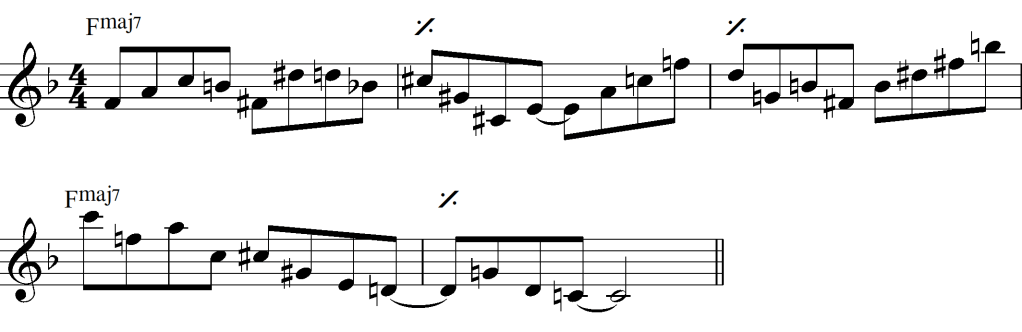
Now we’re getting somewhere!
 Eitan Muir